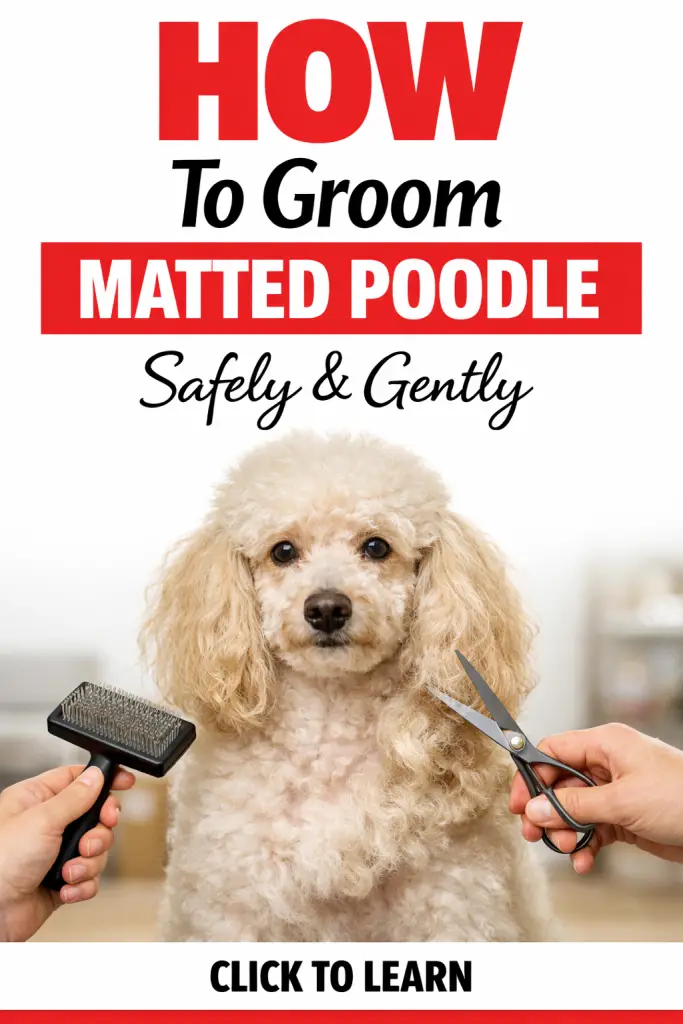
You notice it when you run your hand over your poodle’s coat.
The fur feels tight.
Clumped.
Unnatural.
Mats do not appear overnight.
They build slowly.
One missed brushing turns into many.
You can handle this at home if you work with patience and a plan.
You do not rush.
You do not pull.
You work section by section.
This guide shows you exactly how to groom a matted poodle in a calm, practical way.
What Matted Fur Really Means
Mats form when loose hair tangles and tightens.
Poodles shed into their coats instead of dropping hair.
That hair traps:
- Moisture
- Dirt
- Oils
- Dead skin
Over time, the tangle compresses into a solid mass.
Mats often appear in specific areas:
- Behind the ears
- Under the collar or harness
- Armpits
- Inner thighs
- Tail base
Have you checked those spots lately?
Why You Should Act Early
Mats change how your poodle feels and moves.
They pull on skin with every step.
They trap moisture against the body.
I once ignored light mats behind my poodle’s ears for two weeks.
They tightened fast.
By the time I addressed them, grooming took three times longer.
Early action saves time and effort.
Late action limits your options.
Tools You Need Before You Start
You cannot improvise this.
Right tools change everything.
Gather these items first:
- Slicker brush with fine bent pins
- Metal comb with wide and narrow teeth
- Mat splitter or dematting tool
- Dog-safe grooming scissors with rounded tips
- Detangling spray or light conditioner
- Clippers with a clean, sharp blade
- Non-slip surface or grooming table
Place everything within reach.
Stopping mid-session breaks momentum.
Prepare Your Poodle Properly
Preparation sets the tone.
Start with a calm environment:
- Quiet room
- No distractions
- Good lighting
Let your poodle sniff the tools.
Touch gently.
Speak normally.
You want cooperation, not resistance.
Keep sessions short:
- 10 to 20 minutes at a time
- Breaks between sections
Does your dog tense up quickly?
That tells you when to pause.
Never Brush Dry, Tight Mats
Dry brushing tight mats wastes effort.
It also increases discomfort.
Always soften the mat first.
You can use:
- Detangling spray
- Light conditioner diluted with water
Apply directly to the mat.
Work it in with your fingers.
This step alone can cut grooming time in half.
Start With Finger Separation
Before any tool touches the coat, use your hands.
Gently pull the mat apart with your fingers:
- Start at the edges
- Move inward
- Work slowly
You are loosening structure, not removing hair yet.
Even dense mats often hide weaker points.
Find them.
Use the Mat Splitter Correctly
A mat splitter breaks mats into smaller sections.
It does not remove the mat in one pass.
Hold the splitter parallel to the skin.
Insert it into the mat from the tip side, not the base.
Then:
- Slice outward
- Stop
- Reposition
Repeat until the mat separates into thin strands.
Once divided, brushing becomes possible.
Brush From the Ends, Not the Roots
This step matters more than any other.
Always brush mats like this:
- Start at the very tip of the hair
- Clear small sections
- Move closer to the skin gradually
Never drag a brush through the full mat.
Use short strokes.
Lift hair as you work.
If the brush stops, you stop.
Switch Between Brush and Comb
Do not rely on one tool.
Use this pattern:
- Slicker brush to loosen
- Wide-tooth comb to check progress
- Narrow-tooth comb to finish
If the comb does not pass through, the mat is not gone.
That feedback keeps you honest.
When Clipping Is the Better Choice
Some mats cannot be saved.
That is reality.
Thick, solid mats near the skin often require clipping.
Use clippers like this:
- Blade flat against the skin
- Move slowly
- Follow hair growth
Never angle the blade into the mat.
If you feel resistance, stop and reassess.
Short coats grow back.
Skin comfort matters more than length.
Groom One Section at a Time
Do not chase random mats.
Work systematically.
Follow a clear order:
- Head and ears
- Neck and chest
- Front legs
- Body sides
- Back legs
- Tail
Finish one area before moving on.
This keeps progress visible.
It also keeps your dog calmer.
Pay Extra Attention to Ears
Ears mat faster than any other area.
The reason is simple:
- Friction
- Moisture
- Fine hair texture
Hold the ear leather in your hand.
Brush hair away from the ear base.
This prevents skin pulling.
I learned this after my dog started pulling away every time I brushed his ears.
Once I supported the ear, grooming became easier.
Grooming Armpits and Inner Legs
These areas test patience.
Hair here is:
- Thin
- Soft
- Easily tangled
Use extra conditioner.
Work in very small sections.
Keep the leg slightly extended.
This reduces skin folds.
Short strokes only.
No rushing.
Take Breaks Without Guilt
You do not win points for speed.
If your poodle shows stress signs:
- Turning away
- Lip licking
- Stiff posture
Stop.
A five-minute break can save a full session later.
Progress over perfection.
Clean Up After Dematting
Once mats are removed, reset the coat.
Brush the full body lightly.
Check with the comb.
Then trim uneven areas if needed:
- Around paws
- Under the tail
- Face edges
This step gives your poodle a neat finish.
Bathing After Heavy Mat Removal
Bathing works best after mats are gone.
Wet mats tighten.
Clean coats brush easier.
Use:
- Mild dog shampoo
- Thorough rinse
- Towel dry gently
Follow with light brushing as the coat dries.
This prevents new tangles from forming.
Set a Grooming Schedule That Works
Mats form from inconsistency.
You avoid this with routine.
For most poodles:
- Light brushing every other day
- Full grooming once a week
Short sessions beat long ones.
Ask yourself this.
Can you spare five minutes today to save thirty minutes later?
Realistic Expectations for Coat Recovery
After heavy mat removal, coats may look uneven.
That is normal.
Hair grows back faster than you expect.
Within weeks, the coat evens out if you maintain it.
The goal is comfort and health.
Looks come second.
Common Mistakes That Create More Mats
Many owners create mats without realizing it.
Avoid these habits:
- Skipping brushing after baths
- Leaving collars on constantly
- Using human brushes
- Rushing through grooming
Each one adds friction or tension.
Small choices stack up.
Build Trust Through Consistency
Grooming is not just maintenance.
It is relationship work.
When you groom calmly and regularly:
- Your poodle relaxes faster
- Sessions get shorter
- Results improve
Your dog remembers how grooming feels.
Make it predictable.
Make it steady.
When Professional Help Makes Sense
Some situations exceed home grooming.
Severe matting over large areas limits safe handling.
Professional groomers have:
- High-powered clippers
- Experience with difficult coats
- Time to manage complex cases
Choosing help is not failure.
It is responsible care.
Final Thought to Keep You Going
Matted coats feel overwhelming at first.
They are manageable with method and patience.
You do not need perfection.
You need consistency.
Every small session makes the next one easier.
Your poodle feels that effort.