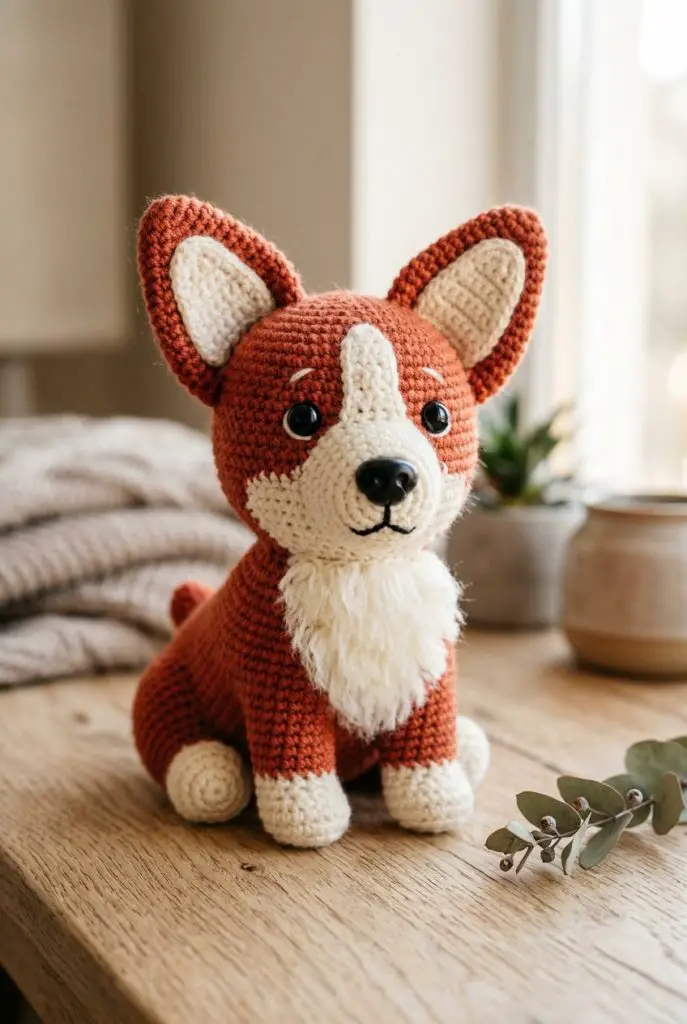
Corgis have two instantly iconic features — dramatically oversized upright ears and a long, low body perched on surprisingly short, stubby legs. Both traits make this breed exceptionally fun and rewarding to recreate in crochet.
Corgis are beloved worldwide for their playful personalities and famous royal connections, making a handmade corgi plush a deeply meaningful gift. A crocheted corgi is a keepsake that dog lovers treasure for years.
This pattern is completely free with no sign-up required, and includes full instructions, a materials list, assembly steps, and color and marking guidance for multiple coat varieties. Let’s get started.
Pattern at a Glance
| Detail | Info |
|---|---|
| Skill Level | Beginner–Intermediate |
| Finished Size | Approx. 6 inches tall × 7 inches long |
| Yarn Weight | Worsted (Category 4) |
| Hook Size | US G/6 (4.0mm) |
| Stitch(es) Used | Single crochet, magic ring, slip stitch, increase, invisible decrease |
| Techniques Used | Amigurumi in the round, color changes, surface embroidery |
| Time to Complete | 6–10 hours |
| Stuffing Needed | Polyfill fiberfill |
| Safety Eyes | 9mm black safety eyes (x2) |
| Number of Pieces | 12 (Head, Muzzle, Body, 2 Outer Ears, 2 Inner Ears, 2 Front Legs, 2 Back Legs, Tail) |
| Yarn Colors Needed | Fawn/Red, White/Cream, Black (small amount) |
| Best Occasion / Use | Corgi owner gift, birthday keepsake, nursery decor, craft fair |
Materials You Will Need
Here is everything needed to complete this corgi amigurumi from start to finish.
Yarn
- Fawn/Red (Main Body Color): Approx. 150 yards — Lion Brand Vanna’s Choice in “Terracotta” — this warm reddish-fawn closely matches the classic Pembroke Welsh Corgi’s iconic coat color.
- White/Cream (Muzzle, Chest Panel, Paw Tips): Approx. 60 yards — Red Heart Super Saver in “Soft White” — use for the muzzle face, chest blaze, and paw tips to replicate the breed’s defining white markings.
- Tan/Honey (Inner Ear Shading): Approx. 15 yards — Caron Simply Soft in “Autumn Maize” — adds the slightly darker warm shading visible on the inner cup of real corgi ears.
- Black (Nose Embroidery): Small amount only — Lion Brand Vanna’s Choice in “Black” — used for nose embroidery and optional eye outline detail only.
Tools & Notions
- US G/6 (4.0mm) crochet hook
- Polyfill fiberfill stuffing
- Two 9mm black safety eyes (or black embroidery floss for child-safe version)
- Tapestry needle
- Stitch marker
- Scissors
- Straight pins
- Thin cardboard strip or craft foam strip (for ear stiffening)
🛒 Yarn Tip: For a breed-accurate corgi, always choose a warm reddish-fawn main color — cool-toned beige or tan reads as pale and inaccurate against the white chest marking.
Abbreviations & Stitch Guide
The following standard US crochet abbreviations are used throughout this pattern.
| Abbreviation | Meaning |
|---|---|
| MR | Magic ring |
| ch | Chain |
| sl st | Slip stitch |
| sc | Single crochet |
| inc | Increase — 2 sc worked into the same stitch |
| dec | Invisible decrease — insert hook through front loops only of next 2 sts, yarn over, draw through both loops |
| BLO | Back loop only |
| st(s) | Stitch(es) |
| rnd | Round |
| rep | Repeat |
| () x# | Repeat the instructions in parentheses that number of times |
| [ ] | Total stitch count at the end of the round |
| FO | Fasten off |
💡 Invisible Decrease Tip: The invisible decrease inserts through the front loops only of two consecutive stitches, which eliminates the visible gap that a standard decrease creates on the surface. Use it on every decrease round on the corgi’s head and muzzle so the face fabric stays smooth and tightly closed over the stuffing.
Gauge
Gauge: 4 stitches x 4 rows = 1 inch in single crochet using US G/6 (4.0mm) and worsted weight yarn.
For amigurumi, consistent tight tension matters far more than matching exact gauge — a tight fabric closes the stitch gaps so the stuffing never shows through the finished piece.
Free Corgi Crochet Pattern — Complete Instructions
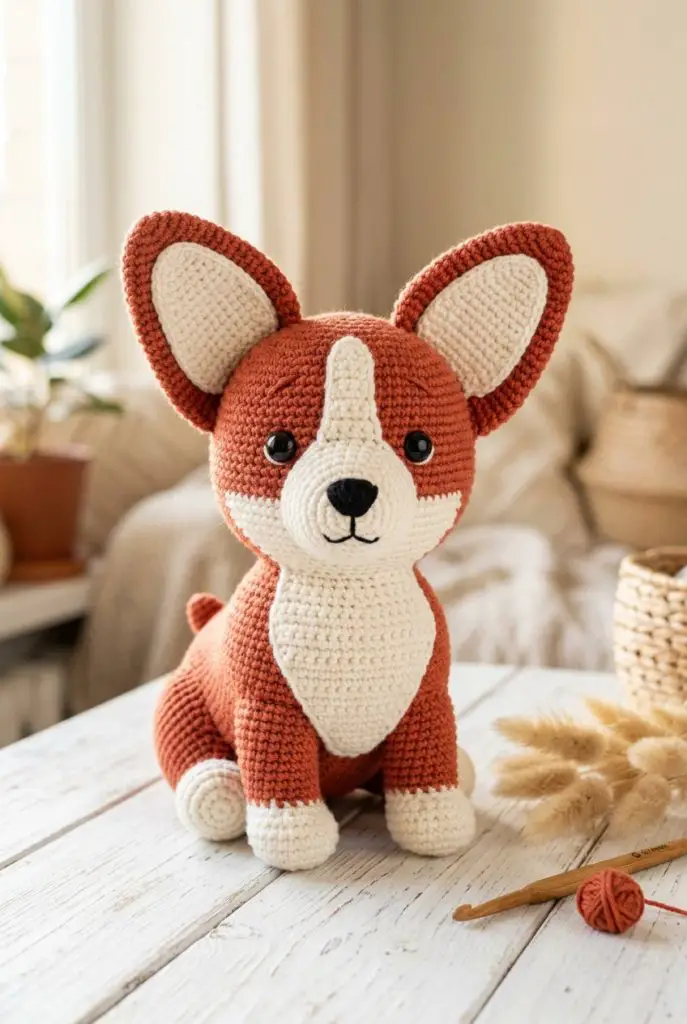
All pieces are made separately and assembled at the end; most parts are worked in continuous rounds with no slip stitch joins, so place a stitch marker at the start of each round and count stitches after every single round without exception.
Head
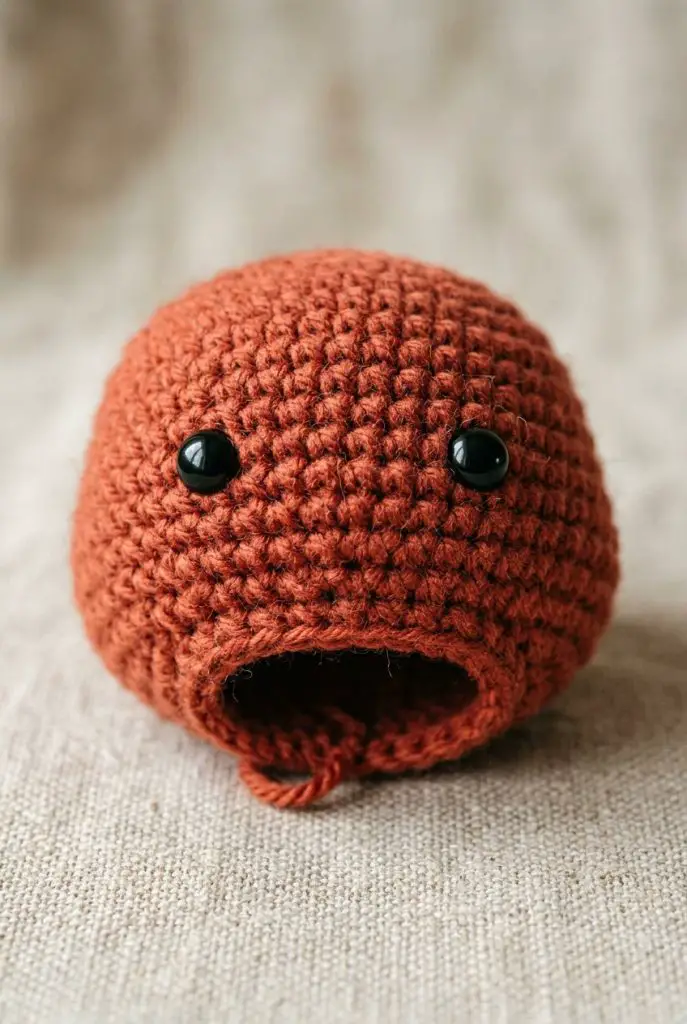
The corgi’s head is wide and slightly flat-topped with a fox-like facial structure — its generous rounded width is the first feature that makes the finished plush instantly recognizable as this breed.
Using Fawn/Red yarn:
Rnd 1: MR, 6 sc into ring. [6]
Rnd 2: (inc) x 6. [12]
Rnd 3: (sc, inc) x 6. [18]
Rnd 4: (sc 2, inc) x 6. [24]
Rnd 5: (sc 3, inc) x 6. [30]
Rnd 6: (sc 4, inc) x 6. [36]
Rnd 7: (sc 5, inc) x 6. [42]
Rnd 8: (sc 6, inc) x 6. [48]
Rnd 9: sc in each st around. [48]
Rnd 10: sc in each st around. [48]
Rnd 11: sc in each st around. [48]
Place 9mm safety eyes between Rnd 11 and Rnd 12, spaced exactly 8 stitches apart on the lower front face.
Rnd 12: sc in each st around. [48]
Rnd 13: sc in each st around. [48]
Rnd 14: sc in each st around. [48]
Rnd 15: (sc 6, dec) x 6. [42]
Rnd 16: (sc 5, dec) x 6. [36]
Rnd 17: (sc 4, dec) x 6. [30]
Begin stuffing the head firmly now.
Rnd 18: (sc 3, dec) x 6. [24]
Rnd 19: (sc 2, dec) x 6. [18]
Rnd 20: (sc, dec) x 6. [12]
Rnd 21: (dec) x 6. [6]
FO, leave a 12-inch tail. Close the remaining 6-stitch gap with a tapestry needle and weave in securely.
💡 Head Tip: Stuff the head very firmly before closing — a densely packed head holds the corgi’s wide, flat-topped profile and prevents the muzzle attachment area from caving inward after the pieces are joined.
Muzzle
The corgi’s muzzle is distinctly pointed and fox-like, lighter in color than the main head, and the single piece most responsible for giving the finished face its signature breed expression.
Using White/Cream yarn:
Rnd 1: MR, 6 sc into ring. [6]
Rnd 2: (inc) x 6. [12]
Rnd 3: (sc, inc) x 6. [18]
Rnd 4: sc in each st around. [18]
Rnd 5: sc in each st around. [18]
Rnd 6: sc in each st around. [18]
FO, leave a 14-inch tail for sewing. Do not stuff — keeping the muzzle flat creates a more natural and breed-accurate corgi face shape.
💡 Muzzle Tip: Pin the muzzle to the lower front of the head, centered below and between the safety eyes at approximately Rnd 16–17 — placing it too high creates a flat-faced appearance that does not read as a corgi.
Outer Ears (Make 2)
The corgi’s large, upright, sharply pointed ears are the breed’s single most iconic feature and must be worked firmly enough to stand on their own without drooping after attachment.
Using Fawn/Red yarn:
Rnd 1: MR, 4 sc into ring. [4]
Rnd 2: (inc) x 4. [8]
Rnd 3: (sc, inc) x 4. [12]
Rnd 4: (sc 2, inc) x 4. [16]
Rnd 5: (sc 3, inc) x 4. [20]
Rnd 6: sc in each st around. [20]
Rnd 7: sc in each st around. [20]
Rnd 8: sc in each st around. [20]
Rnd 9: sc in each st around. [20]
Rnd 10: (sc 3, dec) x 4. [16]
Rnd 11: sc in each st around. [16]
Rnd 12: (sc 2, dec) x 4. [12]
Rnd 13: sc in each st around. [12]
Rnd 14: (sc, dec) x 4. [8]
Do not stuff. Flatten the ear and close by working a row of sc across the open edge through both layers. FO, leave a 14-inch tail for sewing.
💡 Ear Tip: Before sewing each ear to the head, insert a thin strip of craft foam or cardboard inside — this internal stiffener is the key step that keeps the corgi’s ears permanently upright and is the single most important technique difference between a good corgi plush and a great one.
Inner Ears (Make 2)
The inner ear panel in a lighter cream tone adds depth and realism to the corgi’s distinctive large ear cup, preventing the ears from reading as flat or one-dimensional.
Using White/Cream yarn:
Ch 5.
Row 1: sc in 2nd ch from hook, sc 3 across. [4]
Row 2: ch 1, turn, inc, sc 2, inc. [6]
Row 3: ch 1, turn, sc in each st. [6]
Row 4: ch 1, turn, dec, sc 2, dec. [4]
Row 5: ch 1, turn, (dec) x 2. [2]
FO, leave a 10-inch tail. Sew the inner ear panel flat onto the front face of each outer ear before attaching the assembled ear to the head.
Body
The corgi’s body is long and low relative to its leg height, giving this breed its famous sausage-like silhouette — that elongated shape is what makes the finished plush look unmistakably corgi rather than generic dog.
Using Fawn/Red yarn for the main body and White/Cream for the chest panel:
Rnd 1: MR, 6 sc into ring. [6]
Rnd 2: (inc) x 6. [12]
Rnd 3: (sc, inc) x 6. [18]
Rnd 4: (sc 2, inc) x 6. [24]
Rnd 5: (sc 3, inc) x 6. [30]
Rnd 6: (sc 4, inc) x 6. [36]
Rnd 7: sc in each st around. [36]
Rnd 8: sc in each st around. [36]
Switch to White/Cream yarn for the chest panel — work the first 12 sts of the round in White/Cream, then switch back to Fawn/Red for the remaining 24 sts.
Rnd 9: (White/Cream) sc 12, (Fawn/Red) sc 24. [36]
Rnd 10: (White/Cream) sc 12, (Fawn/Red) sc 24. [36]
Rnd 11: (White/Cream) sc 10, dec; (Fawn/Red) sc 22, dec. [34]
Rnd 12: sc in each st around in Fawn/Red only. [34]
Rnd 13: sc in each st around. [34]
Rnd 14: sc in each st around. [34]
Rnd 15: sc in each st around. [34]
Rnd 16: sc in each st around. [34]
Rnd 17: (sc 15, dec) x 2. [32]
Rnd 18: sc in each st around. [32]
Rnd 19: sc in each st around. [32]
Rnd 20: sc in each st around. [32]
Begin stuffing the body firmly at Rnd 20.
Rnd 21: (sc 6, dec) x 4. [28]
Rnd 22: (sc 5, dec) x 4. [24]
Rnd 23: (sc 4, dec) x 4. [20]
Rnd 24: (sc 3, dec) x 4. [16]
Rnd 25: (sc 2, dec) x 4. [12]
FO, leave a 15-inch tail for attaching the head. Add a final pinch of stuffing before closing if needed.
💡 Body Tip: As you stuff the body, keep it slightly oval in cross-section rather than perfectly round — this elongated shape creates the corgi’s low, wide-chested silhouette and prevents the plush from looking like a generic ball-bodied stuffed animal.
Front Legs (Make 2)
Corgi front legs are short, thick, and slightly bowed, with rounded white paw tips that form one of the breed’s most charming and recognizable small details.
Using White/Cream yarn for the paw section:
Rnd 1: MR, 6 sc into ring. [6]
Rnd 2: (inc) x 6. [12]
Rnd 3: sc in each st around (BLO). [12]
Rnd 4: sc in each st around. [12]
Switch to Fawn/Red yarn.
Rnd 5: sc in each st around. [12]
Rnd 6: sc in each st around. [12]
Rnd 7: sc in each st around. [12]
Rnd 8: sc in each st around. [12]
Rnd 9: sc in each st around. [12]
Rnd 10: sc in each st around. [12]
Rnd 11: (sc 4, dec) x 2. [10]
Rnd 12: sc in each st around. [10]
Stuff lightly — overstuffing will make the legs protrude stiffly outward instead of hanging naturally against the body sides.
FO, leave a 12-inch tail. Flatten the open end and close with a row of sc through both layers.
Back Legs (Make 2)
The corgi’s back legs are slightly wider at the hip than the front legs and support the famous fluffy corgi rump — that wider hip stance at the rear is what gives the assembled plush its breed-accurate posture.
Using White/Cream yarn for the paw:
Rnd 1: MR, 6 sc into ring. [6]
Rnd 2: (inc) x 6. [12]
Rnd 3: sc in each st around (BLO). [12]
Rnd 4: sc in each st around. [12]
Switch to Fawn/Red yarn.
Rnd 5: sc in each st around. [12]
Rnd 6: sc in each st around. [12]
Rnd 7: sc in each st around. [12]
Rnd 8: sc in each st around. [12]
Rnd 9: (sc 2, inc) x 4. [16]
Rnd 10: sc in each st around. [16]
Rnd 11: sc in each st around. [16]
Rnd 12: sc in each st around. [16]
Rnd 13: (sc 6, dec) x 2. [14]
Stuff lightly.
FO, leave a 12-inch tail. Flatten the open end and close with a row of sc through both layers.
Tail (Pembroke Nub Style)
The Pembroke Welsh Corgi’s naturally very short tail — often called the “corgi nub” — is a tiny but essential breed-accurate detail that real corgi owners will immediately notice and appreciate on the finished plush.
Using Fawn/Red yarn:
Rnd 1: MR, 5 sc into ring. [5]
Rnd 2: (inc) x 5. [10]
Rnd 3: sc in each st around. [10]
Rnd 4: sc in each st around. [10]
Rnd 5: (sc 3, dec) x 2. [8]
Rnd 6: sc in each st around. [8]
Add a small pinch of stuffing.
FO, leave a 10-inch tail for sewing.
💡 Tail Tip: For a Cardigan Welsh Corgi version, continue working sc in each st around for 10–14 additional rounds without decreasing before closing — this creates the longer, fox-like bushy tail that is the most visible external difference between the two corgi breeds.
Assembly
Pin all pieces before sewing and check placement from multiple angles before committing any stitch.
- Embroider the nose onto the center of the muzzle using Black yarn and a satin stitch, filling a small downward-pointing triangle shape.
- Pin the muzzle to the lower front of the head centered between the safety eyes and Rnd 17–18, then sew securely all the way around using the yarn tail.
- Sew the inner ear panel flat onto the front face of each outer ear, insert the cardboard stiffener, then position both ears upright on the head at Rnd 5–6 spaced 10 stitches apart and sew firmly through all layers.
- Sew the head to the front-top of the body with the muzzle facing forward and a slight forward tilt to capture the corgi’s alert, attentive posture.
- Sew the front legs to the lower front sides of the body, just below the white chest panel, angling them slightly downward.
- Sew the back legs to the lower rear sides of the body, positioned wider apart and slightly further back than the front legs to replicate the corgi’s naturally wide-hipped rear stance.
- Sew the tail nub to the upper center back of the body at the rump, positioned high where the body narrows at the final closing rounds.
- Using a small length of Fawn/Red yarn, add two short straight-stitch eyebrow marks above each safety eye at approximately Rnd 9 to complete the corgi’s signature alert expression.
- Weave in all ends securely with at least two direction changes, then tug gently on every limb, both ears, and the muzzle to confirm all joins are tight.
📸 Photo Tip: The front-facing head shot showing those enormous upright ears is the strongest image for Pinterest — place the finished plush on a light wood surface with a small sprig of eucalyptus for a clean, shareable, naturally styled flat lay.
Face Details & Expression Options
The corgi’s face expression is what makes this plush immediately recognizable, so take time to perfect these details before finalizing.
- Classic Corgi Expression: Place 9mm safety eyes between Rnd 11 and Rnd 12, spaced exactly 8 stitches apart, for the breed’s characteristic wide-set and alert gaze.
- Breed Signature Happy-Smile Expression: After the muzzle is attached, embroider a small curved “U” smile in Black yarn at the lower muzzle edge with both ends curving upward toward the cheeks — this captures the famous corgi “perma-smile” expression beloved on social media.
- Alert Eyebrow Expression: Add two small Fawn/Red straight-stitch eyebrow marks above each safety eye at Rnd 9 to recreate the corgi’s most recognized raised-brow attentive look.
- Child-Safe Embroidered Version: Skip safety eyes entirely and use black embroidery floss to satin stitch two solid filled ovals at Rnd 11 spaced 8 stitches apart, adding one short horizontal white straight-stitch highlight across each eye.
Color Guide
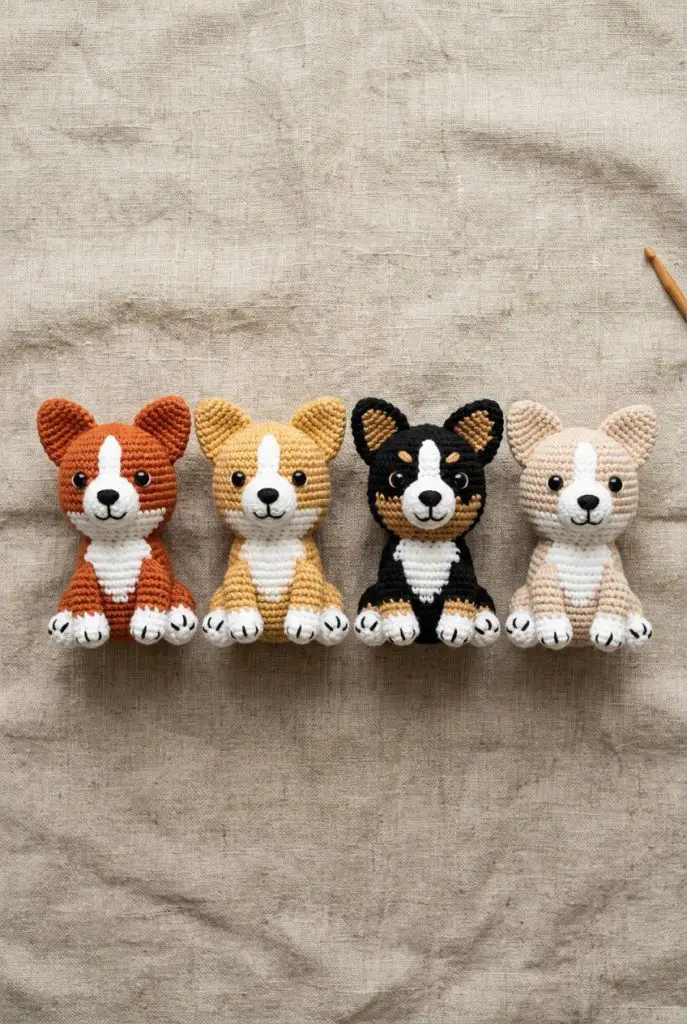
Use this table to match yarn colors to all major recognized Pembroke and Cardigan Welsh Corgi coat varieties.
| Color Variety or Marking | Yarn Recommendation |
|---|---|
| Red & White (Classic Pembroke) | Lion Brand Vanna’s Choice “Terracotta” + Red Heart “Soft White” |
| Sable & White (Pembroke) | Caron Simply Soft “Autumn Maize” + Lion Brand Vanna’s Choice “Fisherman” |
| Fawn & White (Pembroke) | Bernat Super Value “Honey” + Red Heart Super Saver “Soft White” |
| Tri-Color Black Tan & White (Cardigan) | Lion Brand Vanna’s Choice “Black” + “Honey” + Red Heart “Soft White” |
| Blue Merle (Cardigan) | Paintbox Simply DK “Cornflower Blue” held double + Lion Brand “Fisherman” |
| Brindle Point (Cardigan) | Caron Simply Soft “Autumn Maize” + Loops & Threads “Espresso” for brindle streaks |
| White Chest Blaze (All Varieties) | Red Heart Super Saver “Soft White” |
| Most Popular on Pinterest | Red & White Pembroke Welsh Corgi |
Beginner Tips
These tips are specific to the corgi’s unique construction challenges and help beginners avoid the most common breed-specific mistakes.
- Most Important Shaping Technique: Work every single decrease throughout this pattern as an invisible decrease — inserting through front loops only — to keep the corgi’s head and muzzle surface completely smooth and hole-free.
- Most Common Beginner Mistake: Making the ears too small — corgi ears should look slightly oversized on the head, so always complete the full ear pattern before deciding whether the size looks right.
- Tension Advice: Drop down one full hook size from your yarn label’s recommendation if your tension runs naturally loose — a tight, firm fabric is critical for keeping the white chest panel and paw color sections crisp and the stuffing fully hidden.
- Best Assembly Tip: Before permanently sewing the ears, photograph the head straight-on from the front to confirm each ear sits at roughly a 45-degree outward angle — not completely vertical or splayed flat to the sides.
- Most Rewarding Finishing Detail: Adding the small Fawn/Red straight-stitch eyebrow dots above each eye takes under two minutes and is the single detail that transforms the face from a generic stuffed dog into an unmistakable corgi.
Making It Bigger or Smaller
- Mini Keychain: Use fingering weight yarn and a US B/1 (2.25mm) hook to create a 2-inch corgi plush, then attach a metal split ring through the flattened top of the finished piece for the keyring loop.
- Standard Size: As written in this pattern using worsted weight yarn and a US G/6 (4.0mm) hook, the finished corgi measures approximately 6 inches tall and 7 inches long.
- Large Cuddly Version: Use bulky (Category 5) yarn and a US K/10.5 (6.5mm) hook to produce a finished corgi of approximately 11–13 inches long, making a sturdy and huggable nursery stuffed animal.
Safety Notice
- Safety eyes are a choking hazard for children under 3 — always embroider eyes using black floss for any baby or toddler gift.
- Weave in every yarn end with at least 2 direction changes to prevent unraveling during play or washing.
- Check all sewn joins are firmly secure before giving the finished plush to a child by gently tugging each limb, both ears, and the muzzle.
Free Printable Pattern Download
This pattern is free for personal use and for selling finished handmade items in small quantities — the written pattern text must not be reproduced or sold, so please link back to this page instead. At standard 12pt font size with normal margins, this pattern prints to approximately 7–9 pages.
Frequently Asked Questions
How long does this Corgi crochet pattern take to complete?
Most crocheters at a beginner–intermediate level finish this corgi in 6–10 hours across two or three sessions. The ears are the quickest pieces; the body takes the longest.
Can I use DK weight yarn instead of worsted?
Yes — switch to a US E/4 (3.5mm) hook with DK weight and expect a finished corgi of approximately 4–5 inches. All stitch counts stay the same.
My corgi’s ears won’t stand upright — how do I fix it?
Insert a thin strip of craft foam or firm cardboard inside each ear before sewing it to the head, then sew through all layers firmly at the ear base to lock the upright position.
Can I substitute the magic ring?
Yes — chain 2, work all required sc stitches into the second chain from the hook, then pull the yarn tail snug to close the center gap.
How can this pattern be customized to match a specific real-life Corgi?
Match the main body yarn color precisely to the individual dog’s coat shade and adjust or omit the white chest panel to reflect that dog’s actual markings. Custom corgi commissions typically sell for $45–$90 depending on size and detail level.
Final Thoughts
The corgi is one of the most rewarding amigurumi projects because the fox-like face combined with those dramatically oversized ears creates a silhouette no other dog breed shares.
Capturing both features accurately in yarn is genuinely satisfying from start to finish.
The ears require the most patience — attaching the inner panels, positioning each ear at the correct angle, and inserting the stiffener all take careful, repeated adjustment.
The finished result, though, is immediately unmistakable and worth every extra minute of effort.
Share your finished corgi plush on Pinterest with the hashtag #CorgiCrochet so the handmade community can celebrate your work — and if you made it for a real corgi owner, the reaction photos are always the best part. Happy crocheting! 🐾